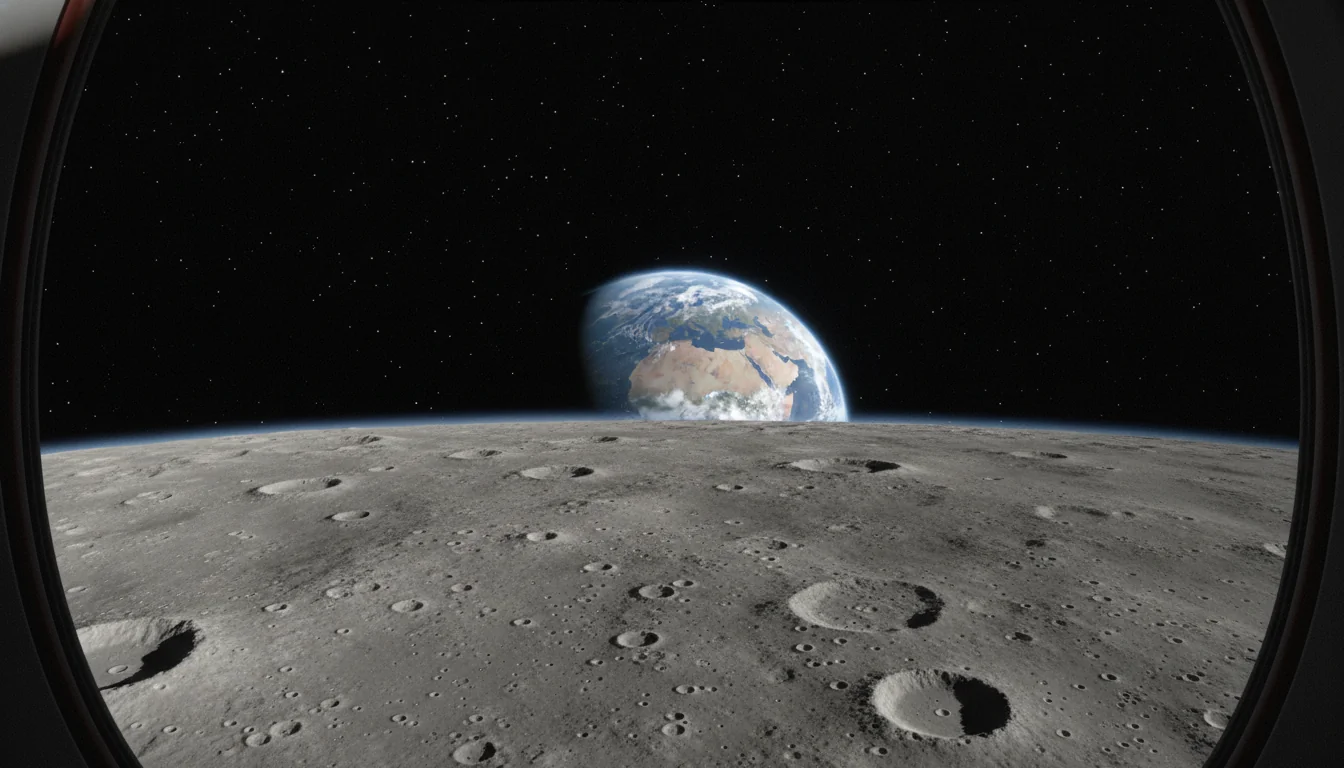
NASA’s Artemis II mission was the Artemis program’s first flight with astronauts aboard Orion: a roughly 10-day journey in April 2026 that included a lunar flyby and safe return to Earth. The crew—NASA astronauts Reid Wiseman, Victor Glover, and Christina Koch, and CSA astronaut Jeremy Hansen—carried cameras to document Earth and the Moon from deep space. Official releases included views framed as Earthset (Earth moving toward the lunar horizon from the spacecraft’s viewpoint during the flyby) and other lunar flyby imagery. This article separates what is confirmed in NASA’s public materials from common mix-ups (especially around the word “eclipse”), then suggests grounded ways to reflect on the mission alongside Moon cycles.
---
What Are the Artemis II Earthset and Flyby Photos?
Earthset (or an Earthset sequence) means Earth appears to set below the local horizon—but on the Moon, “horizon” depends on where you are. The Moon is tidally locked: from most places on the near side, Earth hangs in roughly the same part of the sky and does not rise or set the way the Sun does on Earth. Astronauts in lunar orbit or on a moving spacecraft can see Earth move against the limb because their vantage point keeps changing. Artemis II’s published photography therefore reflects Orion’s trajectory during the flyby, not “standing on the surface watching Earth dip away” in the everyday sense.
The mission is also widely described as offering a solar eclipse view from the spacecraft: as Orion passes behind the Moon relative to the Sun, the Moon can pass in front of the Sun from the crew’s perspective. That is a solar eclipse in the usual astronomical sense (the Moon blocks the disk of the Sun). It is not the same thing as a lunar eclipse seen from Earth (Earth’s shadow on the Moon), and it is not “Earth eclipsing the Sun” in the way a total solar eclipse on Earth is produced by the Moon.
For cultural contrast, Apollo 8’s Earthrise (1968) showed Earth coming into view above the lunar limb as the spacecraft moved. An Earthset sequence is geometry in the opposite direction—Earth sliding toward the limb and out of view—while the emotional effect can feel similar: small Earth, vast space, sharp perspective.
Key reference facts (check NASA press materials for exact figures, which can be refined after flight):
- Mission: Artemis II — first crewed Artemis flight; lunar flyby, not a landing
- Crew: Wiseman, Glover, Koch, Hansen
- Spacecraft: Orion on the Space Launch System (SLS)
- Timing: Launch April 1, 2026; mission duration on the order of 10 days; splashdown April 10, 2026 (Pacific), per NASA reporting
- Closest approach: On the order of 4,000–4,600 miles above the lunar surface (NASA cited about 4,067 miles at closest approach in mission updates)
---
Why Do These Images Matter Scientifically and Culturally?
Science and engineering: High-quality handheld and window photography still helps engineers assess lighting, window clarity, and how crews use optics in deep space. Images also support public communication of trajectory and scale—the Moon “about the size of a basketball at arm’s length” at closest approach is a standard way NASA conveys distance to non-specialists.
Atmosphere and “Earth as a disk”: Dramatic thin crescent Earth views can occur when much of the planet is in night from the crew’s perspective. That is phase geometry, not automatically proof of a particular eclipse type. When in doubt, caption what NASA states for each image rather than inferring.
If ads are unavailable, here are a few helpful places to keep exploring.
Human factors: Astronauts have long reported perspective shifts from seeing Earth from space (often discussed in connection with the Overview Effect). It is fair to say these images can evoke awe and connectedness for viewers; treat specific psychological claims as ongoing research, not settled fact.
Why this still matters from the ground:
- Perspective: Big-picture imagery can pair well with intention-setting or gratitude practices without needing every frame to be “spiritual.”
- Timing: If you track lunations, a historic flyby is a useful reminder that the Moon is a real world with geometry, distance, and light—not only a symbol.
- Accuracy as care: Sharing correctly described images respects both science and readers’ trust.
---
How Might You Connect This Mission to Lunar Cycles (Without Hype)?
In mythology, Artemis is tied to the Moon, liminality, and the wilderness; a lunar flyby named for her invites metaphor lightly: threshold experiences, seeing something from a new angle, or honoring curiosity alongside intuition. You do not need to claim the mission “proves” astrology for it to sit meaningfully next to a new Moon journaling practice or a full Moon release ritual.
Practical, grounded prompts:
1. Look up the Moon’s phase during the flyby window and note what you were personally emphasizing that week. 2. Use one official image as a meditation anchor—breathing with the small blue disk in black space. 3. Journal a single question: “What would change if I saw my life from farther away?” 4. Share NASA-credited imagery so friends get accurate context with the awe.
Lunar Guide’s personalized lunar calendar and daily insights can sit alongside this as everyday rhythm tools—the mission is a rare headline; the Moon is monthly.
---
Where to Find Official Artemis II Imagery
NASA mission media is generally public domain. Start here:
- NASA Image and Video Library — search Artemis II, Orion, Earthset, lunar flyby
- nasa.gov/artemis-ii — mission page and news releases
- NASA on Flickr and official social accounts — curated galleries and crew updates
Tip: Prefer the caption and release that accompany each file. If a keyword search lands on concept art or training photos, say so when you share.
---