Pinterest is, structurally, a vision board platform. It is built for curating visual inspiration into organized collections. The infrastructure already exists — you don't need to buy a poster board, find a printer, or clear space on your wall. What you do need is intention, because Pinterest without intention is just a browsing habit. Pinterest with intention is something else entirely.
Here is exactly how to build a Pinterest vision board that you'll actually use and that will do what vision boards are meant to do: prime your attention toward what you're building, not just what you're escaping.
---
Why Pinterest Works for Vision Boards
A physical vision board is static. Once made, it sits. Pinterest is dynamic — you can add to it, remove from it, reorganize it, and access it on any device at any time. For visual learners who consume a lot of content online, there's also a natural intake pipeline: images you encounter in ordinary browsing can immediately be redirected to your vision board rather than simply passing through your attention and disappearing.
The potential downside of Pinterest is its passive mode. Most people use it to save things they find beautiful without any intentional framework. The result is a board that reflects passing tastes rather than actual aspirations. What follows below is designed to prevent exactly that.
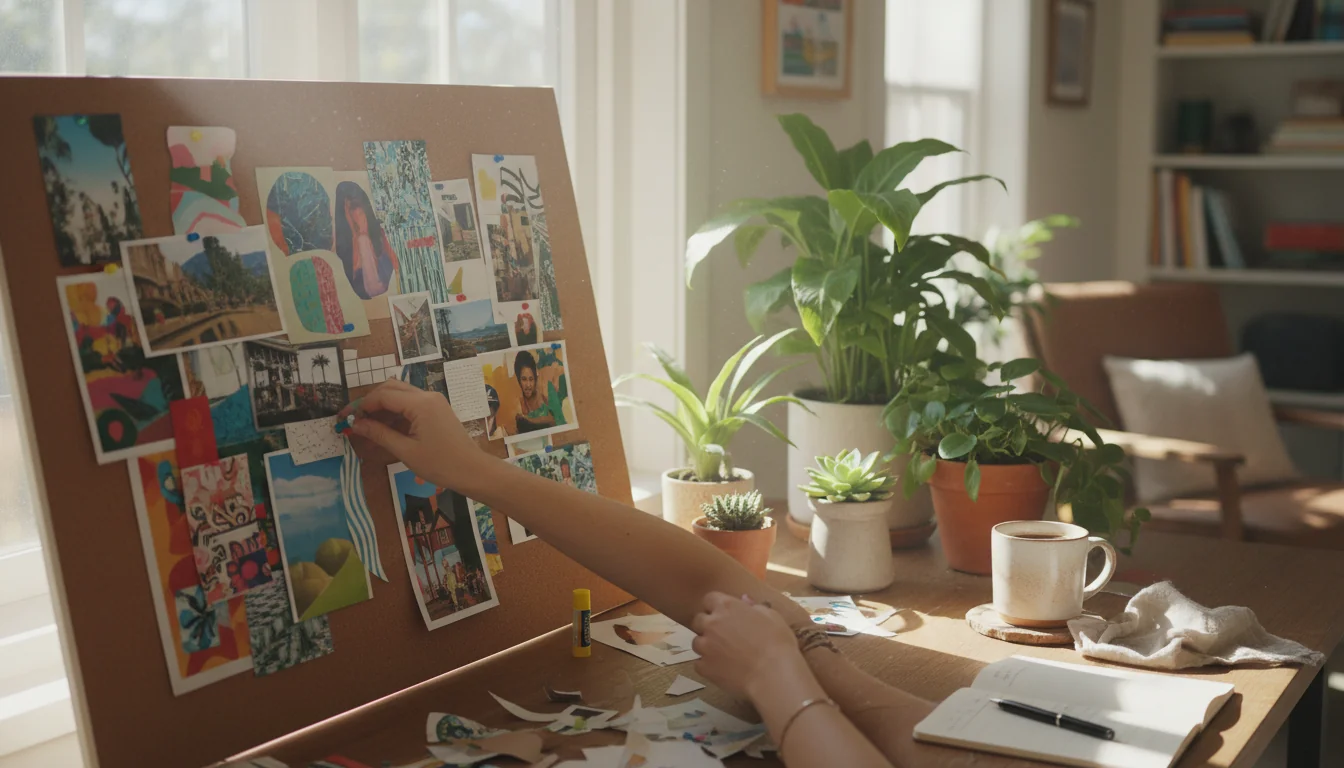
!Hands building a physical mood board — the same intention you’ll bring to Pinterest.
---
Step-by-Step: Building Your Pinterest Vision Board
Step 1: Create a Secret Board With an Intentional Title
Go to your Pinterest profile and create a new board. Make it secret — this matters. Public boards introduce social performance into what should be a private practice. When your board is public, you may curate for how it looks to others rather than what actually activates something in you.
Name it with intention. Not "dream life" or "vision" — something that activates a felt sense when you read it. Examples: "The life I'm already building." "What I'm moving toward." "My actual future." The name is a daily micro-affirmation every time you open the board.
Step 2: Create Sections by Life Area
Pinterest allows boards to be divided into sections. Use this feature to organize your vision board by the areas of life that matter to you. Suggested sections:
- Work and creative life — what your career/creative output feels and looks like
- Body and health — not aspirational fitness content, but images that evoke the feeling of being in your body well
- Home — the physical environment you're cultivating
- Love and relationships — the quality of connection you want to experience
- Financial life — images that represent financial ease, freedom, or abundance (often better conveyed through experiences than money itself)
- Growth and learning — books, experiences, skills
- Travel and adventure
- Inner life and spirit — images that evoke calm, depth, presence
You don't have to use all of these. Cut any that feel forced. The goal is a map of the full life you're designing, not a checklist.
Step 3: Search With Emotional and Sensory Language
This is the most critical technique for building a vision board that actually activates something versus one that just looks nice.
Do not search for literal goal descriptions. "Successful woman" or "dream house" will return generic stock imagery that has no personal charge. Instead, search for the feeling you want to cultivate:
- "morning light linen" instead of "nice bedroom"
- "independent creative work" instead of "career success"
- "quiet abundant life" instead of "financial freedom"
- "easy joy" or "mid-laughing" instead of "happy relationship"
- "salt air wild freedom" instead of "travel goals"
The images that surface from emotionally descriptive searches tend to be more specific, more textured, and more likely to genuinely resonate. When you see an image and feel something — save it. When you see one that looks like it should resonate but doesn't — skip it.
Step 4: Pin With Description Captions
When you save each pin, add a description in the notes section. Write in present tense. Not "I want this" — "This is how my home feels." "This is the kind of work I do." "This is what my mornings look like."
This step takes extra seconds per pin. It's worth it. The act of writing the description is a small ritual of claiming — a moment of saying this is mine, this is real, this is already becoming true.
Step 5: Set a Reminder to Review
Create a recurring reminder — weekly is ideal — to open your Pinterest vision board and spend five minutes with it. This is the ritual that makes the board functional rather than decorative. During this five-minute review:
- Scroll through each section slowly
- Notice what still activates something in you
- Notice what has gone flat
- Remove anything that no longer resonates
- Add anything new that has come to feel important
The board should feel like a living document — not the same board you made six months ago.
---
Using Your Pinterest Board as a Daily Practice
Beyond the weekly review, you can integrate your Pinterest vision board into daily life in a few ways:
Set the board as a daily notification. If you use Pinterest's notification features, set them to surface pins from your vision board rather than trending content. A daily visual pull from your own intentions is more valuable than algorithm-curated browsing.
Use it before decision-making. When you're deciding how to spend time, money, or energy, open your vision board for sixty seconds first. Does this choice align with what's in these images? This is not a rigid rule — it's a directional check-in.
Add pins in real time. When you encounter an image in ordinary browsing that genuinely activates something — a photograph on a website, a screenshot from a story — save it directly to your vision board. Pinterest's browser extension makes this frictionless.
---
What to Do When Pins No Longer Resonate
A pin losing its charge is information, not failure. It usually means one of three things:
1. You've integrated what that image represented. You've already moved toward it, and it's no longer aspirational — it's becoming real. This is worth celebrating. Move it to an archive section called "Becoming True."
2. You've outgrown the vision. What you thought you wanted six months ago doesn't fit who you're becoming. Remove it without guilt. Your vision board is not a commitment — it's a living map.
3. It was never truly yours. Some pins that initially seem to resonate reveal, over time, that they represent someone else's life or what you thought you should want. Let these go freely.
---
Moon Phase Timing for Pinterest Vision Board Work
Aligning your Pinterest vision board updates with the lunar cycle gives the practice a natural rhythm and deepens its intentionality.
New moon — the new moon is the optimal time to add new pins, write new descriptions, and set fresh intentions. The new moon phase is associated with beginnings and planting seeds. Apps like Lunar Guide make it easy to track exactly when the new moon occurs each month. Treat the night of the new moon as your "board building" session.
Full moon — the full moon is the natural time for honest review. What has shifted? What is no longer true? What have you called in that deserves to be acknowledged? The full moon's energy supports releasing what no longer serves and celebrating what has manifested.
Between phases — the waxing phase (new to full) is active time: work toward what's on your board. The waning phase (full to new) is clearing time: simplify, archive, and create space for what's next.
---
Common Pinterest Vision Board Mistakes
Saving too many pins without curation. A board with 500 images loses its focus and its charge. Aim for fifteen to twenty-five images per section — enough to feel full but not so many that nothing stands out.
All images, no words. Include at least a few text-based pins — quotes, affirmations, or words that capture the feeling of each life area. The combination of image and language engages different cognitive and emotional pathways.
Making it public. Already mentioned, but worth repeating. The social dimension of public vision boards creates performance pressure that undermines the practice.
Updating only at the beginning of the year. Vision board work tied exclusively to January resets is vulnerable to the same dynamic as New Year's resolutions. Monthly review and the lunar cycle approach make it a sustained practice rather than an annual event.
---
Your Pinterest vision board is only as powerful as the honest attention you bring to building and reviewing it. The platform handles the infrastructure. You supply the self-knowledge, the specificity, and the willingness to actually look at what you're choosing to build toward.
That act of choosing and returning — of looking at what you want on purpose — is itself a form of commitment. And commitment, over time, shapes action.