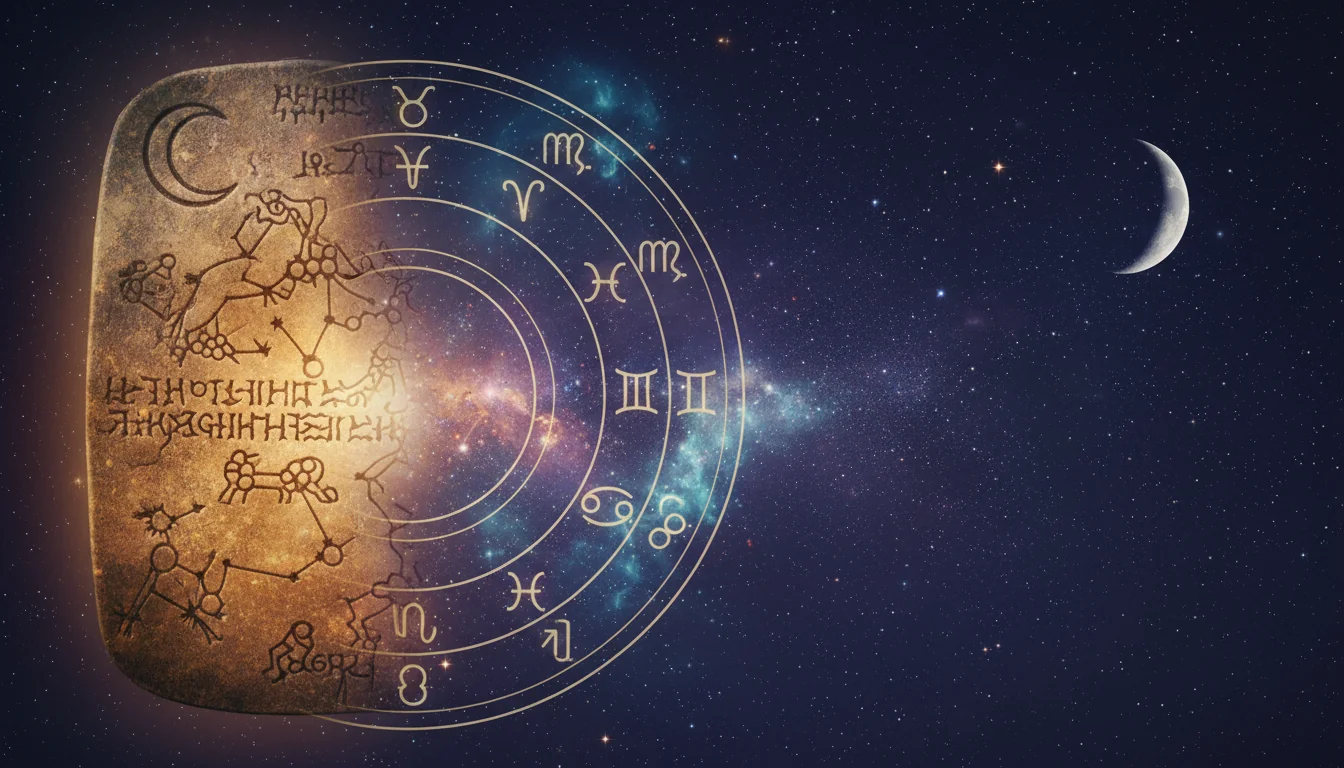
Direct answer: Astrology began in ancient sky-watching traditions, especially in Mesopotamia, where people tracked the Moon, planets, eclipses, seasons, and unusual celestial events for farming, kingship, calendars, ritual life, and public timing. Over many centuries, that practical sky record became a symbolic system for interpreting time, temperament, and change.
If you search for astrology history origin, you will often see one simplified claim: "astrology started in Babylon." That is broadly true for the technical roots of Western astrology, but the fuller story is richer. Astrology developed through layers: Mesopotamian omen records, Egyptian decans, Greek geometry, Roman transmission, Islamic scholarship, medieval medicine, Renaissance philosophy, and modern psychological interpretation.
Astrology today is not identical to ancient astrology. A modern birth chart app and a Babylonian court astrologer were doing very different jobs. But they share one core idea: time has texture, and the sky gives us a language for reading it.
---
Where Did Astrology Begin?
The earliest major roots of astrology are usually traced to Mesopotamia, especially Babylonia. By the second millennium BCE, sky watchers were recording lunar eclipses, planetary appearances, weather patterns, and political events. These records were not "horoscopes" in the modern sense. They were omen texts.
An omen might connect a lunar eclipse with a possible threat to the king, a crop concern, or a political turning point. That may sound strange now, but in the ancient world the sky and the state were not separate categories. Celestial order, divine will, and earthly order were understood as connected.
This early astrology was collective rather than personal. It was concerned with kingdoms, harvests, rulers, floods, wars, and public life. The question was not "What is my personality?" but "What does this sky event suggest about the condition of the world?"
That difference matters. Modern astrology often begins with identity. Ancient astrology began with timing.
---
Why Is Babylonian Astrology So Important?
Babylonian astrologers made one of the most important moves in astrology's history: they turned repeated sky observations into organized prediction systems. They tracked planetary cycles with impressive mathematical skill and built tables that allowed future positions to be anticipated.
Several ideas that still shape astrology have Mesopotamian roots:
- The importance of planetary motion.
- The use of omens connected to eclipses and lunar phases.
- The division of the sky into repeatable zones.
- The belief that celestial cycles could describe earthly timing.
The zodiac as we know it emerged gradually from this tradition. The familiar twelve-sign structure developed as sky watchers divided the ecliptic, the apparent path of the Sun, into sections. This made astrology more systematic. Once the sky could be measured, interpreted, and compared across time, astrology became a technical craft rather than a loose collection of signs.
Babylonian astrology was still not the same as modern natal astrology. But without Babylonian observation, mathematics, and zodiacal structure, later Western astrology would not have had its backbone.
---
What Did Ancient Egypt Contribute to Astrology?
Ancient Egypt also played a major role in astrology's development. Egyptian sky traditions included the decans, groups of stars used to track time through the night and mark seasonal rhythms. These decans were connected to temple ritual, calendars, and the sacred ordering of time.
When Egyptian and Hellenistic ideas later blended, the result was powerful. The Egyptian focus on sacred timing and the Greek focus on geometry helped create the kind of chart-based astrology we recognize today.
This is one reason ancient astrology cannot be reduced to one place or one culture. Babylon supplied key technical foundations. Egypt contributed sacred calendar logic and stellar timing. Greece then synthesized many of these ideas into a more personal chart system.
---
When Did Birth Chart Astrology Begin?
Hellenistic astrology, developing in the centuries after Alexander the Great, is where natal astrology becomes recognizable. This period brought together Babylonian planetary methods, Egyptian decans, Greek philosophy, and mathematical astronomy.
Several chart concepts became central:
- The Ascendant: the sign rising on the eastern horizon at birth.
- Houses: twelve life areas connected to topics like money, family, relationships, career, and health.
- Aspects: geometric relationships between planets.
- Planetary rulerships: the idea that certain planets have special relationships with certain signs.
- Lots: calculated points such as the Lot of Fortune.
This is the period when astrology became more personally focused. Instead of only reading omens for kings and cities, astrologers could cast a chart for an individual birth. The chart was treated as a map of a life: temperament, fortune, timing, vocation, relationships, and challenge.
If ads are unavailable, here are a few helpful places to keep exploring.
That does not mean ancient astrologers thought every detail was fixed. Different schools debated fate, character, divine order, and free will. But the birth chart became a serious interpretive document.
For beginners, this is the bridge between ancient history and the chart you see today in an astrology app. Your planets, signs, houses, and aspects all descend from this Hellenistic synthesis.
---
How Did Astrology Spread Through the Roman World?
Astrology spread widely through the Roman world. Emperors consulted astrologers, philosophers argued about fate, and ordinary people encountered astrology through calendars, medicine, and popular prediction.
Roman astrology was not always welcomed. Some rulers expelled astrologers when predictions became politically inconvenient. That tension followed astrology for centuries: it was useful, popular, and intellectually serious, but also controversial because it dealt with power, fate, and uncertainty.
As the Roman Empire changed and classical institutions declined in the West, astrological knowledge did not simply disappear. It moved, translated, and reappeared through new intellectual centers.
---
How Did Islamic Scholars Preserve and Expand Astrology?
From roughly the eighth through thirteenth centuries, scholars in the Islamic world translated, preserved, critiqued, and expanded Greek, Persian, Indian, and other astronomical and astrological texts. This period was essential for astrology's survival and refinement.
Astrology was studied alongside astronomy, mathematics, medicine, and philosophy. Scholars calculated planetary tables, translated major texts, and developed techniques that later entered medieval Europe.
This matters because many modern summaries skip over the translation history. Astrology did not travel in a straight line from Greece to modern apps. It passed through multilingual scholarly cultures. Each culture preserved some methods, questioned others, and added new layers.
---
How Was Astrology Used in Medieval and Renaissance Life?
By the medieval period in Europe, astrology was woven into several areas of life. It was used in medicine, agriculture, weather prediction, politics, and spiritual timing. Physicians sometimes considered planetary hours or lunar phases when planning treatments. Farmers watched lunar cycles. Rulers consulted astrologers about coronations, alliances, and military campaigns.
Renaissance astrology became even more elaborate. Intellectuals debated astrology's place in Christian theology, natural philosophy, and medicine. Some treated it as a symbolic science of correspondences: planets, metals, herbs, body systems, temperaments, and seasons all connected in a grand pattern.
This period also produced more printed almanacs and public forecasts. Astrology became more available to everyday readers, not only courts and scholars.
---
Why Did Astrology Lose Academic Status?
Astrology and astronomy were once closely linked. Over time, they separated. Astronomy became a modern empirical science focused on measuring celestial bodies and physical laws. Astrology remained an interpretive symbolic system.
The scientific revolution changed what counted as reliable knowledge. Controlled measurement, repeatable experiments, and mathematical physics became the standard. Astrology did not consistently meet that standard, so it lost its place in universities and official science.
That does not mean astrology disappeared. It shifted cultural roles. Instead of being a courtly or medical discipline, it became a symbolic, spiritual, psychological, and popular practice.
This distinction is important for trust. Astrology is not astronomy. It is not a modern science in the way physics or biology is. Its value is interpretive: it offers pattern language, timing reflection, and meaning-making.
---
How Did Modern Astrology Become About Self-Understanding?
Modern astrology changed dramatically in the nineteenth and twentieth centuries. Newspaper horoscopes made Sun-sign astrology popular. Theosophy, Jungian psychology, humanistic astrology, feminism, and New Age spirituality all reshaped the field.
The biggest shift was from prediction to self-understanding. A modern astrologer is often less likely to say "this event will happen" and more likely to ask:
- What pattern is repeating?
- What part of your chart is being activated?
- What timing cycle are you in?
- What choice would align with the lesson of this transit?
This is where astrology became personal growth language. The Moon sign describes emotional needs. Venus describes relating. Mars describes desire and action. Saturn describes structure and responsibility. The chart becomes a mirror, not a sentence.
Lunar Guide fits into this modern lineage by making timing practical. Instead of asking readers to memorize thousands of years of technique, it helps translate lunar cycles and personal chart patterns into daily reflection and action.
---
What Has Stayed the Same Throughout Astrology's History?
Across the long history of astrology, many details changed. The purpose changed. The audience changed. The techniques changed. But several themes stayed remarkably consistent:
- People look to the sky to understand time.
- The Moon is central because it is visible, rhythmic, and emotionally resonant.
- Planetary cycles help people name periods of pressure, growth, delay, and renewal.
- Astrology becomes most useful when it connects meaning to action.
That last point is the heart of a grounded practice. Astrology is not valuable because it removes uncertainty. It is valuable because it gives uncertainty a shape you can work with.
---