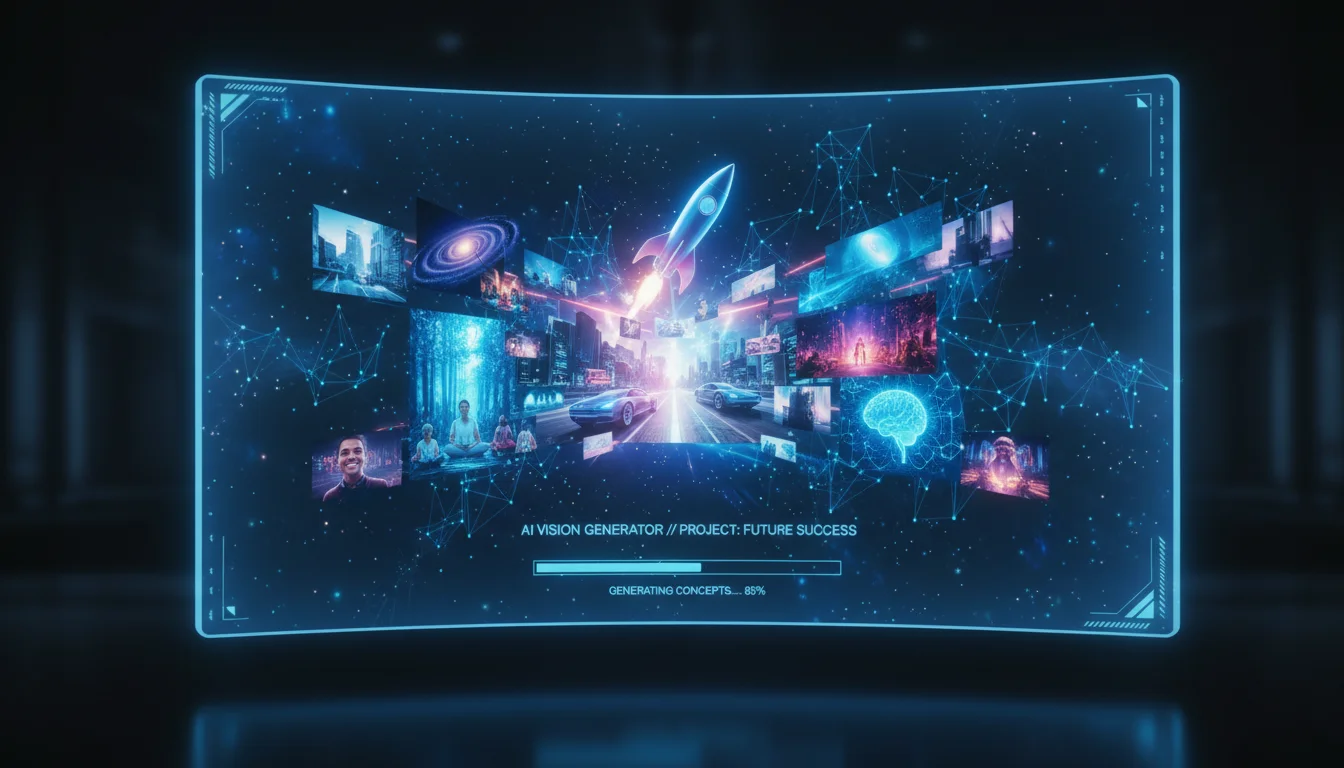
An AI vision board generator is a tool that uses artificial intelligence to automatically create a visual vision board based on your text prompts or goal descriptions. Instead of manually collecting images and arranging them, you describe your vision and the AI generates a customized board for you. The technology has become genuinely capable — boards produced by AI tools can be visually striking and surprisingly resonant. But whether they help you manifest anything depends almost entirely on how you use them, not on the AI itself.
---
How AI Vision Board Generators Work
There are two main types of AI technologies at play in these tools:
Text-to-image AI: Tools like Midjourney, DALL-E, Stable Diffusion, and others generate original images from text descriptions. You might describe "a sun-drenched home office with a view of the ocean and a desk surrounded by plants" and the AI generates an image that matches your words. Vision board tools built on this technology let you describe each area of your vision in text, then generate corresponding visuals.
Image curation AI: These tools work differently — instead of generating new images, they use AI to search and assemble existing images (stock photos, Pinterest-style content) based on your keyword inputs and stated goals. The result is a curated board pulled from existing visual content rather than newly generated imagery.
Some tools combine both: using curation for certain sections and generation for others. The end result is a visual board that reflects your goals without you having to open a browser tab and manually save 40 images.
Platforms currently offering AI-assisted vision board creation include tools like Canva's AI features, DreamBoard, Vizualize.me, and various standalone apps — the landscape is evolving quickly, and new tools emerge regularly.
---
What Makes AI Vision Boards Different From Manual Ones
Speed: A manual vision board using physical magazines can take hours. Digital vision boards in Canva take 30–60 minutes. An AI-generated vision board can take 10 minutes or less. The barrier to having something visual is dramatically lower.
Convenience: No need to flip through magazines, save images to a folder, or design anything. You describe what you want; the AI creates a version of it.
Accessibility: For people who feel they have no design skill or artistic eye, AI generation democratizes the creation process. You don't need to curate well — you need to describe clearly.
These are real advantages. But they come with a significant tradeoff.
---
What AI Vision Boards Lack — and Why It Matters
The process of manually creating a vision board is not just the means to an end. It is part of the practice.
When you search for images of the life you want, you are forced to confront what that life actually looks like to you. The process of scrolling, discarding, saving, and arranging images involves dozens of small decisions — and those decisions are where the real inner work happens. When you reject one image of a "dream kitchen" and save another, you are learning something about yourself that a prompt-generated image can't reveal. When you feel a surge of excitement at one image and flatness at another, your emotional system is giving you important data.
That decision-making process — slow, tactile, emotionally engaged — is what activates the psychological mechanisms that make vision boards useful: clarifying what you actually want, training your attention to notice relevant opportunities, and making your goals concrete enough to act on.
An AI generator that produces a beautiful board based on your description skips most of this. The board might look right. But it's been created more by the AI's interpretation of your words than by your genuine emotional engagement.
This is not an argument against AI vision boards. It's an argument for using them with the level of intentionality that makes any vision board worthwhile.
---
How to Use an AI Vision Board Generator With Genuine Intention
Write your prompts carefully. The quality of what the AI produces is entirely determined by the quality of your input. Vague inputs produce generic outputs. "I want a beautiful home" will produce something forgettable. "I want a home that feels like it's been in the same family for generations — warm, book-filled, with imperfect floors and a garden I've been tending for years" produces something that might actually move you.
The process of writing detailed, emotionally honest descriptions of what you want is itself a manifestation practice. Slow down on this step. Don't rush it.
Review with emotion, not just aesthetics. When the AI delivers your board, don't just notice whether it looks good. Notice how each image makes you feel in your body. Does it produce excitement, peace, recognition — or does it feel like someone else's life that you've decided you should want? Replace anything that doesn't produce a genuine emotional response.
Add your own images. AI generators work best as a starting point, not a finished product. Mix in personal photographs — images from your actual life that already carry meaning, or images you've saved over time that represent something real about your desires. A board that mixes AI-generated imagery with personal photos will feel more like yours than a fully AI-generated one.
Act on what you see. The most effective vision boards are ones that inform daily action, not just daily inspiration. Look at your board regularly and ask: what is one small thing I could do today that moves me toward even one element of this vision?
---
The Role of Timing and Intention-Setting
Many people who work with vision boards intentionally create them at the start of a new year, a new season, or a new moon — using the natural energy of beginnings to anchor the practice. There's wisdom in this. Creating a vision board isn't something you should do while distracted or rushed. It benefits from a quality of presence that aligns well with intentional ritual time.
The new moon, in particular, carries energetic associations with seeds, beginnings, and fresh cycles. If you use Lunar Guide to track the lunar cycle, you already know when new moons fall — and that timing can provide a natural anchor for revisiting or refreshing your AI vision board as your goals evolve throughout the year.
---
Pairing AI Generation With Deeper Practice
AI vision board generators are most useful when they're one layer of a broader intention-setting practice — not the whole thing. Consider using them alongside:
- A written intentions document: A paragraph or two describing the feeling and substance of the life you're building, in your own words
- Regular review rituals: Set a recurring reminder to look at your board and journal briefly on what's emerging and what still feels distant
- Action step integration: Once a week, identify one concrete step toward something on your board
The AI can handle the visual production. You bring the meaning, the emotional engagement, and the follow-through. Without those, the most stunning vision board is just an attractive image file.
---
The Practical Question
Does an AI vision board generator help you manifest? The honest answer: it depends on what you do with it.
The tool is neutral. It produces visuals efficiently. Whether those visuals become a compass that guides your attention and action, or whether they get made and forgotten, is entirely a function of the intention and consistency you bring to the practice.
Lunar Guide offers complementary tools for moon-phase-aligned intention-setting — if you want to ground your vision board practice in a natural rhythm that keeps you returning to it regularly, aligning creation and review to the lunar cycle is a simple and surprisingly effective structure.
Make the board. Then use it.