The new moon occurs when the Moon is positioned between Earth and the Sun, making it invisible in the night sky. It marks the start of a new 29.5-day lunar cycle and symbolizes new beginnings, intention-setting, and fresh starts. In both astronomical terms and spiritual traditions spanning thousands of years, the new moon is understood as a threshold — an ending and a beginning rolled into the same dark moment.
---
The Astronomy Behind the New Moon
At the new moon, the Moon sits roughly between Earth and the Sun — a position called conjunction in astronomical terms. With the Sun illuminating the side of the Moon that faces away from us, we see nothing but darkness where the Moon should be. In some months, this alignment is close enough to create a solar eclipse.
The new moon rises and sets with the Sun, which is why it's invisible during daylight hours and absent from the night sky entirely. It returns to visibility two to three days later as a thin waxing crescent in the western sky just after sunset.
This is day one of the lunar cycle. Over the next 29.5 days, the Moon will grow from nothing to full illumination and back to darkness again — a cycle that has governed tides, agricultural calendars, and human ritual since long before written history.
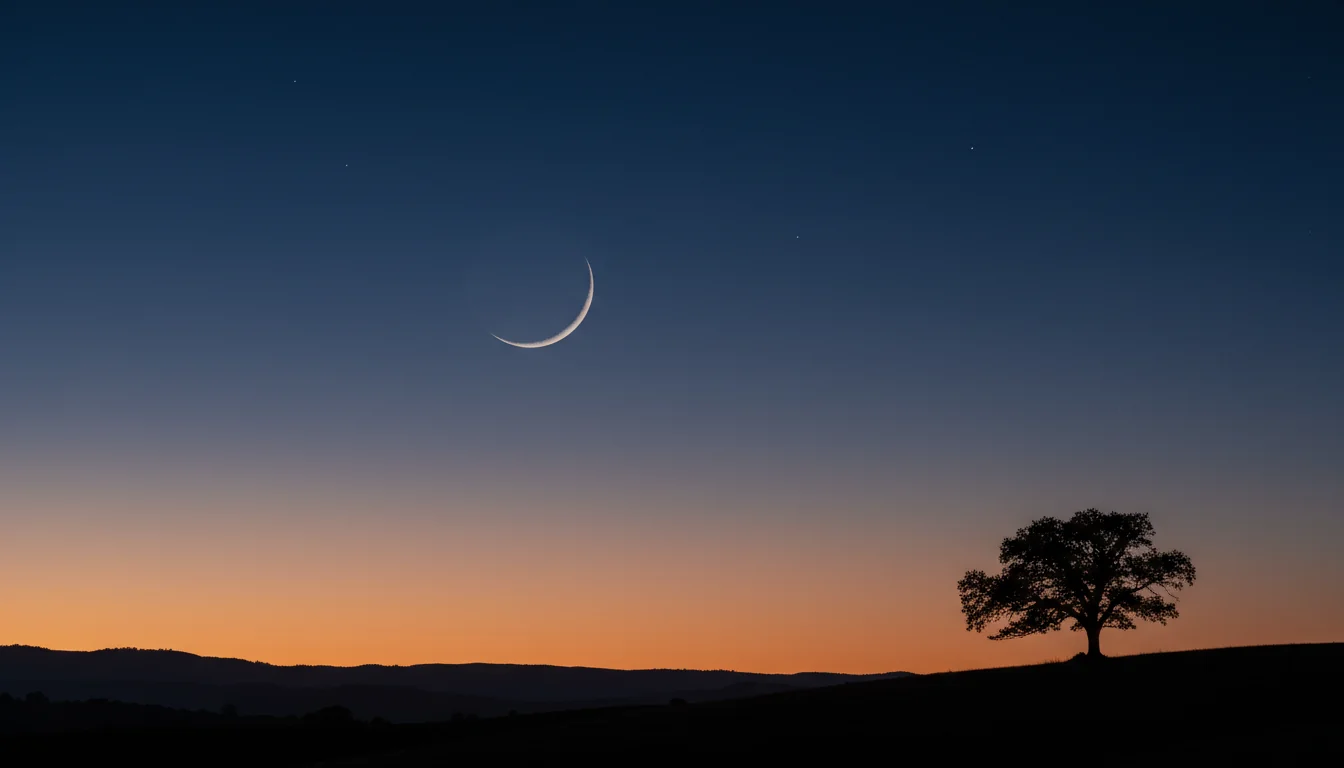
!Thin crescent moon in deep twilight blue sky as the lunar cycle begins again.
---
What the New Moon Means Symbolically
The symbolic meaning of the new moon is remarkably consistent across cultures and traditions that had no contact with each other: it means beginning.
In its darkness, the new moon represents the fertile void — the empty field before planting, the blank page before writing, the silence before music. It is the moment of maximum potential, before any of it has taken form.
In the cyclical model that most spiritual traditions operate from, every ending contains a new beginning. The new moon is the visible expression of that principle. The old cycle has died (the waning crescent, the dark moon), and something new is preparing to emerge.
This is why so many traditions associate the new moon with:
- Intention-setting and new beginnings: Starting projects, relationships, habits, or practices under the new moon is considered auspicious across many cultures.
- Inner reflection and stillness: The dark of the moon is energetically quiet. Many people feel naturally introspective, low-energy, or inward during new moon days.
- Seeds and planting: Agricultural traditions worldwide used new moon timing to plant seeds, mirroring the cosmic principle of beginning.
- Prayer and petition: In Jewish, Islamic, Hindu, and numerous indigenous traditions, the new moon is a sacred day for ritual, prayer, and spiritual renewal.
---
How Different Cultures Have Honored the New Moon
Jewish tradition marks the new moon as Rosh Chodesh — a minor holiday with special prayers, and historically a time of rest for women. The lunar calendar itself governs the timing of every major Jewish holiday.
Islamic tradition uses lunar sighting to determine the beginning of each month, with the new moon crescent marking the start of Ramadan, Eid, and the Hajj pilgrimage calendar.
Hindu tradition observes Amavasya — the new moon day — as a time for ancestor honoring, fasting, and spiritual merit-making. Many Hindu festivals and ceremonies are timed by the lunar calendar.
Chinese culture structures the entire calendar around the lunar cycle, with the new moon marking the start of each month. The Lunar New Year itself begins at a new moon.
Celtic and pagan European traditions considered the new moon a time of quiet power, associated with the maiden aspect of the triple goddess and the beginning of new magical workings.
---
What New Moon Energy Feels Like
If you've ever noticed that you feel unusually tired, contemplative, or emotionally raw around the new moon — you're not imagining it. The gravitational and light-cycle changes around the new moon affect sleep patterns, mood regulation, and energy levels in ways that research is beginning to document.
Many people report:
- Less motivation to be social
- A desire to rest, reflect, or spend time alone
- A sense of emotional clearing or release
- Vivid dreams in the days just before the new moon
- A subtle feeling of anticipation or readiness for something new
This isn't weakness or low mood — it's attunement. The new moon is not a high-energy time. It's a rest-and-recalibrate time. Working against that by pushing hard and staying external tends to feel draining. Working with it by going inward tends to feel right.
---
How to Work With New Moon Energy
The new moon's invitation is simple: pause, reflect, and plant seeds for what you want to grow.
Set intentions, not goals. Goals are specific, measurable outcomes. Intentions are directional — they describe a quality of experience you want to cultivate. "I intend to create more space for rest in my life" is an intention. Intentions feel right for the new moon because they're seeds, not blueprints.
Begin new things. If you've been waiting for the right moment to start something — a creative project, a new habit, a difficult conversation, a new chapter — the new moon is that moment. The energy of beginning is strongest here.
Clear before you plant. In the day or two before the new moon (the dark moon), many people find it powerful to let go of something — a resentment, a habit, a story about themselves — so the new cycle starts clean.
Spend time in quiet. Even 15 minutes of stillness, journaling, or meditation on the new moon day can help you tune into what this cycle wants to bring you.
---
A Simple New Moon Ritual
You don't need anything elaborate to honor the new moon. Here is a ritual that takes less than 20 minutes:
1. Find a quiet space. Light a candle if you like. 2. Take a few slow breaths and let the busyness of the day settle. 3. Write down 1–3 intentions for the coming lunar cycle. Make them honest, not impressive. 4. Read them aloud, even quietly to yourself. 5. Set the paper somewhere you'll see it over the next two weeks. 6. Blow out the candle and go to sleep early if you can.
That's it. The power isn't in the ceremony — it's in the conscious attention you're bringing to the beginning of something.
---
Tracking the New Moon
Knowing when the new moon falls each month allows you to align your planning, creativity, and rest cycles with natural rhythms rather than fighting against them. Lunar Guide tracks the new moon and all lunar phases in real time, so you always know where in the cycle you are and what kind of energy is available to you.
The new moon asks one question every month: what do you want to grow? Your answer — even a quiet, uncertain one — is enough to begin.