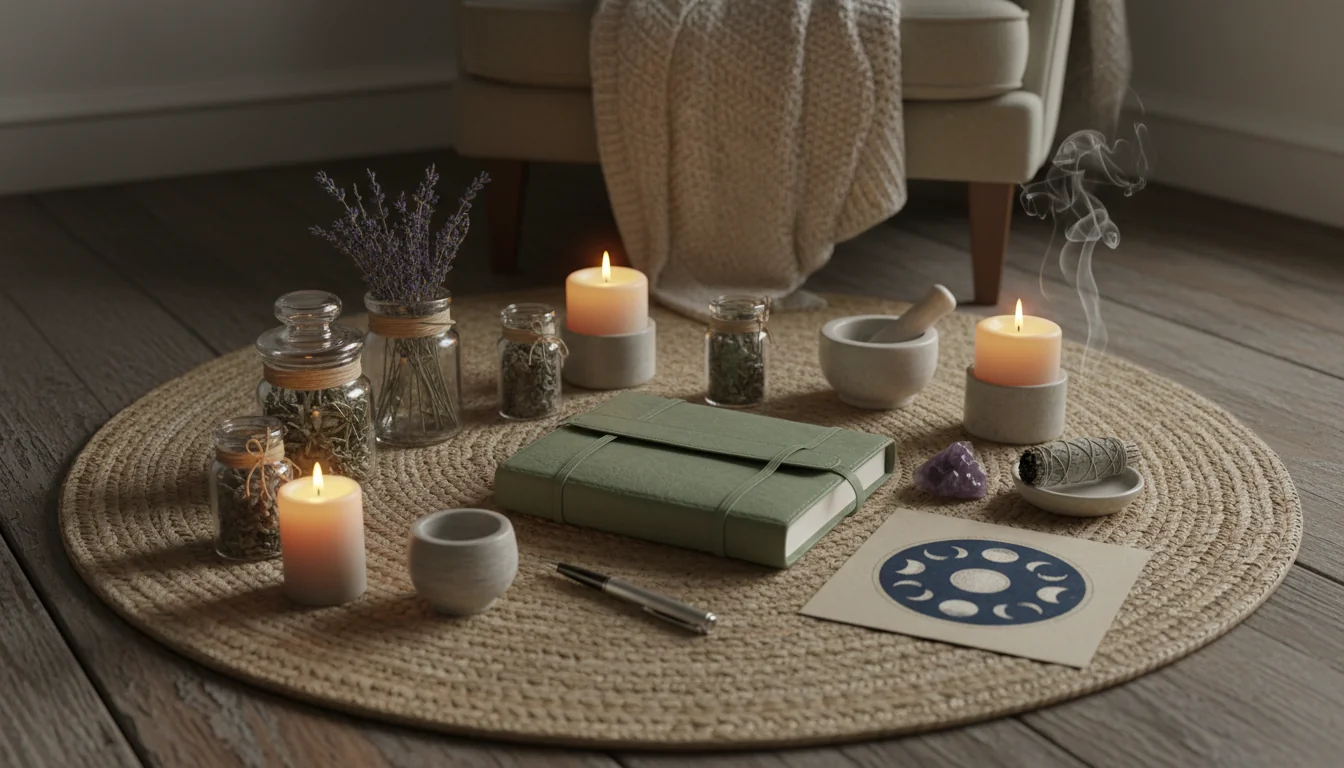
Direct answer: Natural anxiety relief includes breathwork, movement, sleep support, reduced stimulant load, grounding, journaling, social support, and sometimes carefully chosen herbs or supplements. Through an astrology lens, moon phases can help you time when to begin, build, review, and simplify those supports.
Through an astrology lens, those supports become easier to time. The Moon gives you a monthly rhythm. Your elemental makeup gives you clues about what kind of support may feel natural. The goal is not to replace care. It is to make care more personal and repeatable.
If anxiety is intense, persistent, or disrupting your life, please seek professional support. Natural tools can help, but they are not a substitute for therapy, medication, medical evaluation, or crisis care when those are needed.
---
What Counts as Natural Anxiety Relief?
Natural anxiety relief usually refers to non-prescription practices and lifestyle supports such as:
- breathing exercises
- walking and gentle movement
- sleep routines
- reducing caffeine or alcohol triggers
- mindfulness and grounding
- journaling
- herbal teas or supplements
- social connection
- sensory calming tools
- time outside
Some of these have stronger evidence than others. Breath, movement, sleep, therapy skills, and reduced stimulant load are foundational. Supplements and herbs can be useful for some people, but they require more caution, especially if you take medication, are pregnant, have health conditions, or are supporting a child.
For the biology behind the stress response itself, read What Is Stress?.
---
Which Natural Anxiety Supports Have the Strongest Backing?
Everything on that list gets called natural. They are not equally supported.
Tier One: Foundations Worth Building First
Each has a mechanism you can feel working:
- Sleep regularity. Steady sleep and wake times anchor your body clock, and an under-slept brain reacts harder to anything resembling threat.
- Aerobic movement. It gives stress chemistry somewhere to go, and teaches your body that a fast heartbeat is survivable — the sensation anxiety misreads as danger.
- Morning daylight. Early bright light sets the circadian timing that makes an evening wind-down possible.
- Less caffeine and alcohol. Caffeine reproduces anxiety physically. Alcohol trades a calm evening for a jumpier morning.
- Breathing practices. A longer exhale nudges your system toward recovery, and it is the only lever here you can reach mid-spike.
- Social connection. Nervous systems regulate off each other; a steady person nearby settles you in a way self-talk cannot.
None of these are a rescue; they change the conditions you live in, so anxiety has less to build on. For the physiology underneath, see what stress actually does inside the body.
Tier Two: Popular, but Weakly Supported or Highly Variable
Most herbal products and supplements sit here. The evidence is not absent, just thinner, mixed, or tied to a preparation that may not match your bottle. They are not held to the testing standards prescription medication is, so strength and purity vary, and expectation alone can genuinely calm you. Layer them onto Tier One as experiments, never as replacements.
---
Are Natural Anxiety Supplements and Herbs Actually Safe?
Natural is a marketing word, not a safety rating. Plants contain active compounds — that is why anyone takes them — and they can do more than the one thing you wanted.
- Regulation is inconsistent. Supplements are often sold without proving they work or match their label. A missing warning is not evidence of safety.
- Interactions are the real risk. Herbs can interact with prescription medication, including sedatives, antidepressants, and blood thinners. Two things that both cause drowsiness add up.
- More is not gentler. You will not find doses here; the right amount, if any, depends on a history someone needs to see.
Ask a clinician or pharmacist first if you are pregnant or breastfeeding, managing a health condition, taking any prescription medication, considering something for a child, or scheduled for surgery. And never stop prescribed medication to try a natural option — change treatment with your prescriber.
---
How Can You Use the Moon as an Anxiety Care Calendar?
Anxiety often worsens when care is random. Moon phases can create a simple review loop.
The value is structural, not mystical: anxiety care fails when nobody schedules the review. Four checkpoints a month fix that. If the phases are new, the complete guide to moon phases and lunar cycles explains the sequence, and tonight's moon phase shows where you are.
New Moon: Choose One Support
Pick one practice for the cycle: a bedtime, a walk, a breathing exercise, or a journaling cue. Start smaller than your ambition.
Waxing Moon: Make It Visible
Put the practice on the calendar. Set reminders. Tell one supportive person. Build structure while energy is increasing.
Full Moon: Notice What Peaks
Emotions can feel louder near a full moon for many people. Whether you see that astrologically or psychologically, use it as a check-in. What gets amplified? What needs release?
Waning Moon: Reduce Triggers
Simplify. Reduce one input, one commitment, or one avoidable source of nervous system noise.
---
What Natural Anxiety Support Fits Your Zodiac Element?
Read these as starting hypotheses, not assignments. If your chart says fire but your anxiety runs cold and quiet, believe your body and borrow from another element.
Fire: Cool the System
Fire-sign anxiety can feel urgent, hot, and restless. Try evening walks, cooling breath, fewer stimulants, and practices that let energy discharge without creating more pressure.
Earth: Create Physical Safety
Earth-sign anxiety often needs tangible reassurance. Try weighted blankets, warm meals, body scans, budget clarity, cleaned surfaces, and consistent sleep.
Air: Reduce Mental Load
Air-sign anxiety responds to fewer open loops. Try thought labeling, inbox limits, decision lists, and five-minute meditations that focus on breath or sound.
Water: Build Emotional Boundaries
Water-sign anxiety can absorb the room. Try journaling, salt baths, private time, clear endings after emotional conversations, and compassion that includes limits.
---
What Is a Simple Natural Anxiety Relief Routine?
Try this for one week.
Morning: Orient
Before checking your phone, look toward natural light and take five slow breaths. Ask: "What kind of support does my nervous system need today?"
Afternoon: Move
Walk for five to ten minutes if possible. If not, stretch your calves, shake your hands, and lengthen your exhale. Anxiety needs a physical exit. When a walk feels like too much negotiation, yoga for stress and anxiety relief covers gentler options.
Evening: Downshift
Write one line: "The fear says ___, and the next small step is ___." Then choose one sensory calming cue: warm tea, dim light, soft music, a shower, or clean sheets.
This routine is intentionally plain. The body trusts repetition more than drama.
For timing, see the best time to meditate according to astrology.
---
How Do You Build a Personal Anxiety Care Kit?
Anxiety is bad at decisions. Wait until you feel awful and the part of you that would choose well has gone offline. So choose in advance: a short list, sorted by intensity.
Low simmer — functional but tense all day:
- one movement option under ten minutes
- one breathing pattern you know by heart
- one environmental fix: open a window, clear a surface, phone in another room
Keep this tier effortless. If it needs willpower, it will not happen.
Spike — something just hit:
- your fastest physical intervention: long exhale, cold water, feet pressing into the floor
- a technique rehearsed while calm, such as tapping for anxiety relief
- one person you can text with a pre-agreed signal
- somewhere you can step away to for four minutes
Hard day — it arrived heavy:
- the two things that must happen, and permission to drop the rest
- food and water, even if unimpressive
- one comfort you know works: shower, blanket, a particular playlist
- the number or booking link for your therapist, doctor, or a crisis line
Write those numbers down now, while it is easy.
---
How Do You Test One Change Fairly Over Two Weeks?
Most people cannot tell whether relief is working because they changed five things at once, then judged by memory. A fairer method:
Pick one variable. Caffeine cut off after noon, lights out by eleven, a ten-minute afternoon walk. One. A bundle cannot tell you which piece mattered.
Decide what you will notice first. Two or three markers you can rate in seconds: minutes taken to fall asleep, tension out of ten at 4pm, how often worry took over the afternoon.
Hold everything else steady. Avoid starting a supplement, a workout plan, and a screen curfew in the same fortnight. Expect the first few days to be noisy — caffeine reduction in particular feels worse before it helps.
On day fifteen, read your notes, not your mood. One rough day at the end can bury two good weeks in memory. Keep it if the markers moved, adjust timing or size if it half-worked, drop it if it did nothing.
This is personal evidence, not proof — two weeks cannot separate a real effect from a calmer fortnight. But it gives a clinician something concrete: what you tried, tracked, and noticed.
---
When Should You Get More Support for Anxiety?
Natural support is not enough if anxiety includes panic that feels unmanageable, thoughts of self-harm, inability to sleep for extended periods, avoidance that shrinks your life, substance dependence, or symptoms that feel new and physical. In those cases, professional care is not a failure of natural living. It is care.
Astrology can help you reflect on timing. It should never talk you out of getting help.
---